A ‘pipe dream of EU hawks-: What-s in Brussels- new Arctic Strategy?
A ‘pipe dream of EU hawks-: What-s in Brussels- new Arctic Strategy?
The European Commission is preparing for “global power competition” with Russia in the Arctic
The EU has updated its Arctic strategy, and militarism has replaced climate activism as Brussels’ new preoccupation in the frozen north. Despite what the new strategy claims, however, the Arctic is not the EU’s Northern Neighborhood.
Unveiled on Tuesday by the European Commission, the ‘Strategy for the Arctic’ describes the region as a critical zone for trade, investment, and conservation, and a flashpoint for military confrontation with Russia.
With Russia and China increasing their footprint and ambition, the Arctic has become a front line of global power competition, top EU diplomat Kaja Kallas said in a statement. Our revamped Strategy reflects this new reality and puts security firmly at its core.
To understand just how dramatic this new focus on security is, it’s necessary to turn back the clock to 2021, when the commission released its previous Arctic strategy.
The EU’s green pastPublished on October 13, 2021, the strategy opened by describing climate change as the most comprehensive threat the Arctic is facing. Russia’s refurbishment of Soviet-era military bases along its Arctic coastline was presented primarily as something that could further aggravate the consequences of climate change, and the EU pledged to work with Moscow to improve environmental and health security, and to leave military relations with Russia up to NATO and individual member states.
An excerpt from the EU's 2021 Arctic Strategy Four months later, Brussels severed relations with Moscow and entered the Russia-Ukraine conflict on Kiev’s side. The title of the 2021 strategy – ‘A stronger EU engagement for a peaceful, sustainable and prosperous Arctic’ – needed an update that reflected the EU’s new militarism.
Brussels claims the ArcticRussia’s unprovoked and unjustified war of aggression against Ukraine has reshaped the security of the Arctic and the EU as a whole, the new document opens, going on to assert that the Arctic is not someone else’s frontier. It is Europe’s Northern Neighbourhood and the European Union is part of the Arctic.
Geography is not exactly on Brussels’ side here. The 27-member union has no coastline on the Arctic Ocean, and only two of its members – Finland and Sweden – have territory inside the Arctic Circle (although a Danish dependency, Greenland left the EU in 1985). Russia accounts for 53% of the Arctic Ocean’s coastline, and 45% of all land inside the Arctic Circle.
To compensate for this, the new strategy proposes that all waters north of 60 degrees latitude be considered ‘Arctic’. The commission argues that this would allow its environmental regulations to cover the actual footprint of Arctic shipping. It would also dramatically expand the EU’s ‘Arctic’ territory and population by bringing almost all of Finland and Sweden into the new region, including Finland’s entire 1,340 kilometer border with Russia. It is on this frontier that the EU is preparing for conflict.
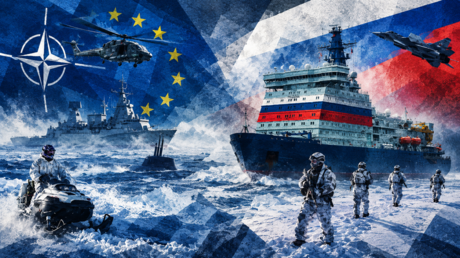
War preparationsThe strategy sets out a lengthy list of military objectives, with the commission promising to:
Deepen engagement with NATO and hold military exercises focused on moving troops and equipment into the Arctic
Develop military logistics corridors from central Europe to the Arctic
Upgrade ports and airports for military use
Expand icebreaker capacity
Expand satellite surveillance of the region and tracking of Russian oil tankers
Develop polar-capable undersea drones
Establish a Maritime Security Hub and increase data-sharing with NATO
Deepen military ties with Canada, Iceland, Norway, the UK, and US
The strategy is short on some specifics, and almost all of these goals are presented without an accompanying price tag. The only actual figures listed are €260 million for te







 25.4c